


2026-06-17 11:19:10
When Adam sat down at a public piano in Leeds city centre, he wasn’t expecting to draw a crowd — but within minutes, shoppers had stopped, phones were out, and applause rang in the air.
It had all the ingredients of a viral moment, except it was real life: spontaneous, human and actually authentic! The magic happened in the moment rather than online.
Adam’s story is a reminder that it’s often society’s barriers — not a lack of talent or potential — that prevent learning disabled people from being seen for who they truly are.
For Adam, 61, music has always been his language. As a small child, he would watch his father play the piano before climbing onto the stool himself, working out the melodies entirely by ear.
“As soon as he was big enough, he started playing,” said his sister, Dagmar. “He must have only been four or five.”
More than five decades on, music remains central to Adam’s life.
Now living in supported accommodation in Leeds with support from learning disability charity Hft, his piano takes pride of place in the living room, where impromptu performances for housemates are part of everyday life.
“I’ve loved music since I was little,” said Adam. “When we have parties, I always play. I love performing for my housemates.”
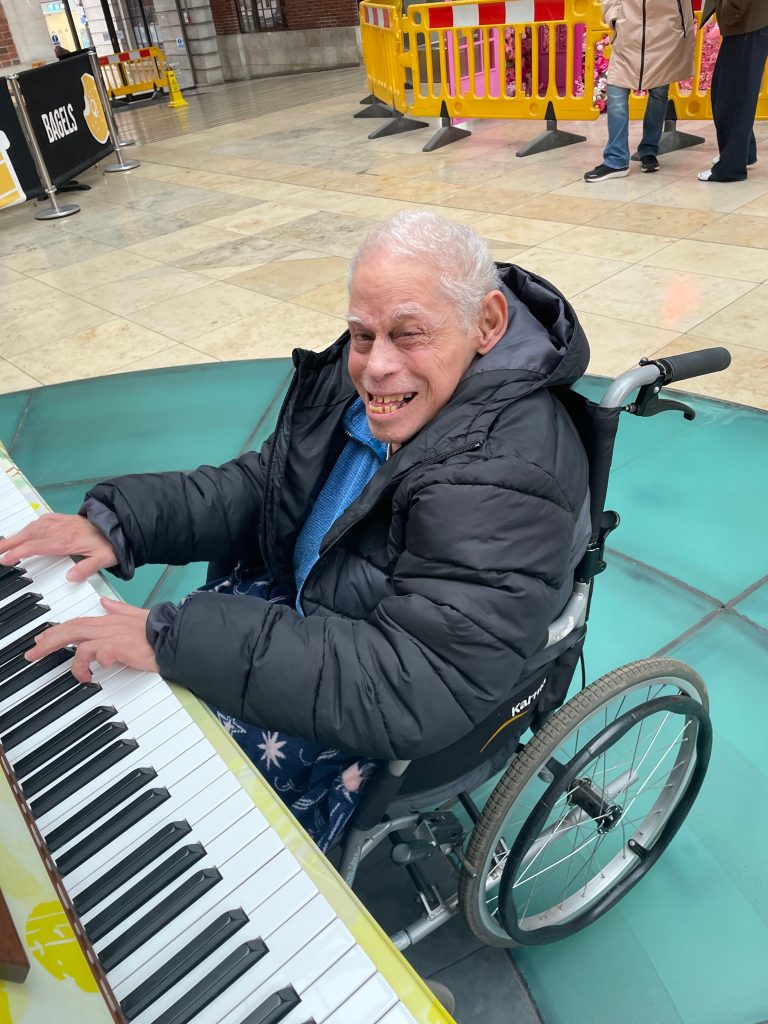
Hft enables Adam to share his music far beyond home. He performs at a local nursing home, plays at Hft’s Free 2 Be Social club in Garforth, and recently wowed crowds on the Leeds piano trail.
Sometimes, the moments are unexpected. On a recent bus journey, Adam began singing ABBA songs — soon joined by passengers and even the driver.
“A lady told me she’d had a really bad start to her day,” Adam said. “After singing with us, she said she felt so much better. She gave me a big cuddle and said thank you.”
Adam’s story highlights the importance of learning disabled people being enabled to follow their passions — whether that’s music, sport, art or work — and the powerful role this plays in wellbeing, confidence and connection.
When people are encouraged, enabled, and empowered to do what they love, it doesn’t just enrich their own lives; it brings joy, understanding, and creates shared moments with the community.
Supporting passions is not an added extra — it’s central to enabling learning disabled people to live full, meaningful lives and society recognising someone’s whole self.
Music has always been how Adam connects with people.
“Adam has a gift for bringing people together. Wherever he goes, music follows,” said Dagmar.
“At Hft, our role is to support people to live the lives they choose. Adam’s passion, talent and love of life inspire everyone around him,” said his support worker Jane.
This Learning Disability Week, Hft is calling on people to challenge the barriers that still exist for learning disabled people - seeing people for who they are and what they can be. Because when you meet Adam, the question isn’t ‘Do you see disability?’ It’s ‘Do you see the musician?’
Find out more about our campaign: Learning Disability Week 2026
Notes to editors
For further information please email media.enquiries@hft.org.uk
About Hft
Proudly established in 1962 by a group of visionary parents, Hft is a charity supporting more than 2,500 learning disabled adults in England and Wales. Together, we are creating a future where learning disabled people and their families can live the best life possible.
Providing personalised support. Creating solutions for living independently. Coming together to campaign for positive change. Fundraising for new opportunities and a bigger impact.
In 2033, we’ll live in a world where learning disabled people have greater choice. About where they live. The support they need and want. And how to spend their time and money.
Learning disability versus difficulty
A learning disability is different from a learning difficulty but the terms are often confused and used inter-changeably. A learning difficulty does not affect general intellect, whereas a learning disability is a life-long condition characterised by a reduced intellectual ability and struggle with everyday activities.
–
For more information about Hft please visit www.hft.org.uk


